Call for speed cameras on Alcester Road

Speed camera sign outside King David School

Following requests from residents on Alcester Road, myself & Philip Mills are calling for a re-introduction of speed cameras on Alcester Road outside Park Hill and King David schools.

There were Gatso cameras in both locations until approx 15 years ago, when they were switched off.

Since then speeding and racing has increased including through Moseley Village.

We are asking for Alcester Road to be included in the next round of average speed cameras to be installed in the city.

Please sign our petition which will be submitted at the next full council meeting:

Making the case for traffic enforcement

This week Councillor Colin Green and I successfully took a motion to full council to urgently roll out Moving Traffic Enforcement cameras across the city.

This is the third motion on road safety I have taken since being elected. Some progress has been made, but it is no where near enough.

I outline in my speech how the failure to consistently enforce traffic rules is causing resentment and division.

At the same meeting my colleague Philip Mills asked a question to the Cabinet member about the councils poor response to enforcement of pavement parking. Philip is severely sight impaired so this is something that impacts him and other disabled people every single day.

Kings Heath and Moseley LTN – Traffic Regulation Orders

The Traffic Regulation Order consultation for Kings Heath & Moseley Places for People (PfP) aka Low Traffic Neighbourhood (LTN) scheme opens on Monday 15 September and runs until Monday 6th October 2025.

Following public consultation and engagement activities on the proposals for Kings Heath & Moseley PfP, and subsequent amendments to the plans based on this engagement, the council are now at the stage of formalising the proposals through a consultation on the Traffic Regulation Orders (TRO).

During this consultation, residents/businesses and organisations are invited to make comments on the proposals or submit a formal objection (which must include the grounds for the objection).

A letter outlining the TRO will be delivered to all residents and businesses within the area of the scheme.

Details of the measures can be found on the online consultation and sets of the TRO documents will also be available at Kings Heath Library and Kings Heath Community Centre. (Opening times of the venues will need to be checked before attending).

In addition, to the TRO’s the council are proposing the following changes which can be implemented with a Traffic Notice rather than a TRO:

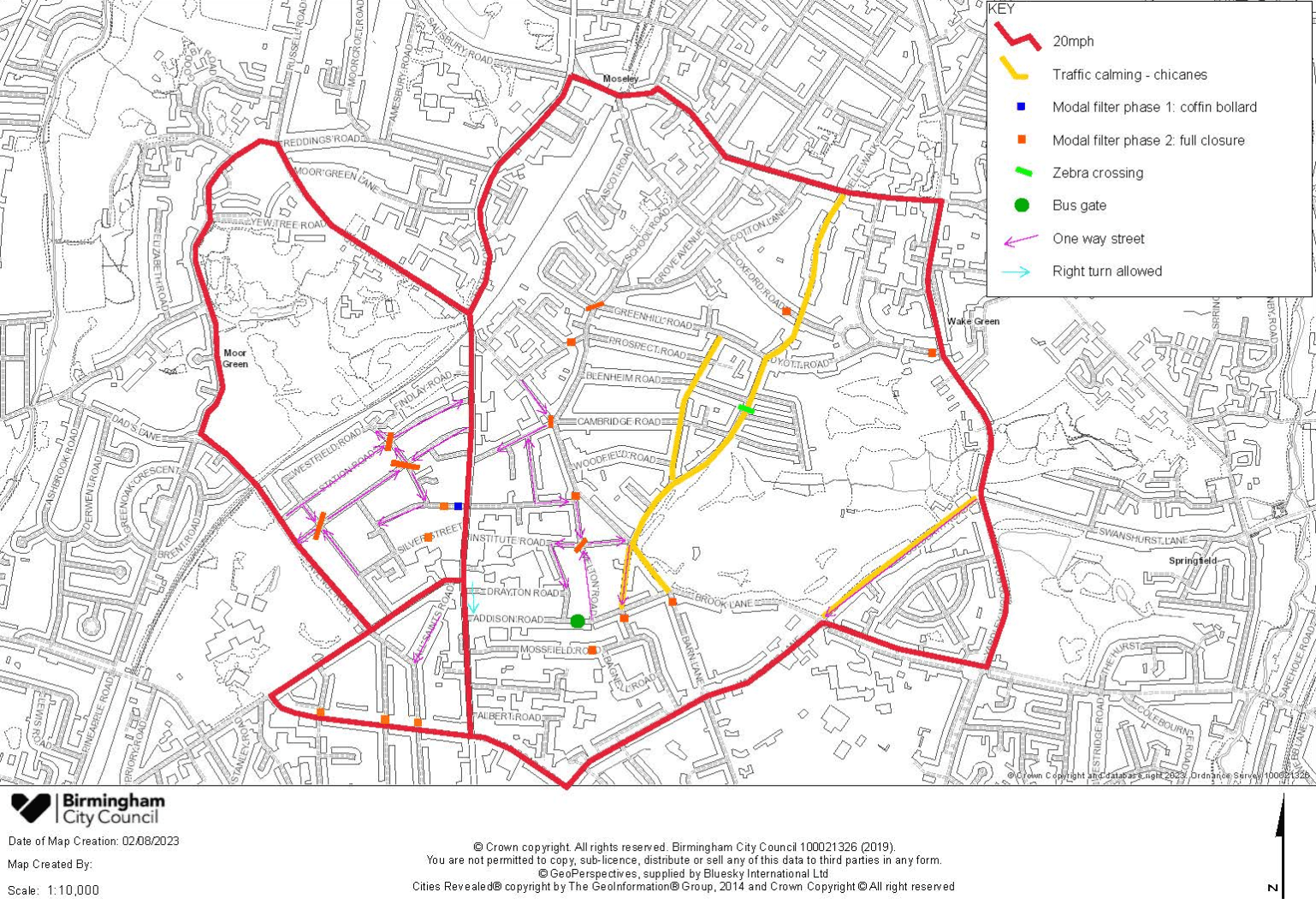
  • Traffic calming measures on Billesley Lane, Springfield Road, Clarence Road and Gaddesby Road to reduce vehicle speeds and improve safety
  • Zebra crossing on Billesley Lane to improve pedestrian safety

The link to the online consultation and all the plans is: www.birminghambeheard.org.uk/bcc/kheath-moseleytro

If you have any questions about this consultation, or need help understanding the plans, please contact: KingsHeathandMoseleyTRO@birmingham.gov.uk

West Moseley Traffic Reduction Scheme – withdrawn

Earlier today the Cabinet Member for Transport and Environment, Cllr Majid Mahmood made the decision to end the consultation into the West Moseley Traffic Reduction Scheme and not to proceed with the trial.

Issues such as volume of traffic, speeding, dangerous driving and parking are regularly brought to my attention and have a huge negative impact on our communities. I have supported residents and schools in their campaigns for road safety measures and increased enforcement and I have shared their frustration when they fail to get any commitment to address their concerns, either due to lack of funds or out of date policies and priorities and when previously agreed schemes have been later cancelled. I have submitted at least six petitions, taken two successful road safety motions to council to change policy and contributed to a scrutiny enquiry into the council response to road safety and enforcement.

This is why, together with Councillor Jenkins, I was supportive of the councils request to take this scheme to residents in a consultation, as their views and feedback are extremely important to me. I tried to explain the rationale behind the scheme and its aims and benefits, of which I was also supportive, to enable a more informed decision to be made.

I have carefully listened and responded in full to the large amount of feedback received over the first two weeks of the consultation.

Although I have had some very positive responses, the vast majority of feedback  is that people feel traffic will be displaced causing congestion to other roads and driving routes will be longer and more difficult.

I have also taken into account the representations made by the parents of pupils at Special Educational Needs (SEN) schools in Queensbridge Road concerning the impact on childrens’ travel arrangements. I think they raise valid concerns and more time should be taken to consult and consider their needs.

The Experimental Traffic Regulation Order (ETRO), if implemented would have run for 12 months from the end of April.  This will coincide with works at the entrance to Kings Heath Train station, followed by extensive works at Moseley Train Station, lasting well into the summer, followed by  Phase 2 of the Kings Heath & Moseley Places for People scheme, which will not be fully implemented until Spring 2026.

I cannot therefore rule out the impact of traffic congestion or hold ups caused by all these other works, on being able to properly evaluate the West Moseley scheme.

My report sent to officers yesterday is that now is not the time to implement a scheme such as this. We need to wait until Phase 2 Kings Heath and Moseley Places for People is consulted, installed and bedded in and the train stations are open and running and then we can re-evaluate the situation in West Moseley. We can use that time to further engage with the community and schools to explore other possible solutions, with the objective of applying for sufficient future funds. I have an open mind to study any ideas to improve road safety that are put forward.

I would like to publicly thank the council officers who tried their best, under very difficult financial restraints, to find an answer to the concerns raised , whilst also adhering to council policy. The feedback received will no doubt help when planning delivery of future schemes,

Explaining the Rationale for the West Moseley Traffic Scheme

Last week the council published their proposals for the West Moseley Traffic Reduction Scheme. I wrote about the details here

I would like to try to explain the rationale for the proposal to put a modal filter on Moor Green Lane using an Experimental Traffic Regulation Order (ETRO).

Firstly, I would like to reassure residents there are no plans to put a similar filter on Russell Road. That option  was considered by officers, who were looking at possibly incorporating it into the Cannon Hill Park to Moseley cycle lane extension, but it was not taken forward to the design stage.

The proposal for a filter on Moor Green Lane has come about due to the many concerns raised from residents of Russell Road, Reddings Road and Moor Green Lane about the volume of traffic, speeding and dangerous driving in residential roads in West Moseley. Some residents have been campaigning for action for many years.  

Queensbridge Secondary School and Moor Green Primary School report excessive volumes of traffic, inconsiderate parking and speeding. Many parents say they feel their children are unsafe travelling to school by bicycle or foot, and they have no option but to ferry them by car. There are also two special needs schools in the area, Uffculme and Fox Hollies.

A traffic calming scheme proposed  in 2022 for Russell Road was shelved in 2024 due to the excessive cost – approx. £620,000 pounds and rising. Costs of installing infrastructure have increased astronomically since Brexit and the Pandemic.  

It was also felt that the scheme would not reduce the volume of traffic, which is a  priority of the council as part of the Birmingham Transport Plan.

One modal filter in one location is much cheaper to install than a traffic calming scheme over a wider area. A modal filter in Moor Green Lane will likely cost less than a 10th of the previously proposed measures for Russell Road.

As much as everyone wants speed cameras, they are unlikely to be considered a priority for 20mph roads until there is a change of law. Speeding fine revenue goes straight to the government treasury and is used for general government expenditure. This means the cost of installation and maintenance of any speed cameras has to be met by the council and costs of administration of the offences are met by the police, with no revenue coming back other than for speed awareness courses, which does not cover the costs. There are currently only six speeding camera sites in Birmingham. Although work is on going to add more, they will inevitably be placed on arterial A routes within the city.


Neither calming nor cameras will reduce traffic volume, which has got steadily worse in residential streets, mainly due to the use of satellite navigation systems. 

Faced with these barriers to addressing the many complaints and campaigns the council officers looked at a wider area than Russell Road. They discovered most of the traffic travelling through  the West Moseley area comes via Moor Green Lane. They estimated if they stop the through traffic using this route it will reduce the amount of traffic using all the residential streets as a cut through by up to half and most of what will subsequently come into the area will be local.

It is anecdotally argued that local people are less likely to speed or drive dangerously in their own neighbourhoods. Indeed, if you look at roads where through traffic is restricted there is evidence of a much lower rate of collisions.

Less traffic, fewer collisions and reduced amount of speeding will make the area much safer, especially outside the schools. 

There is of course a potential for the traffic to be displaced to other roads. This is why the proposal would be undertaken with an experimental /trial order rather than an immediate permanent one. There would be monitoring of traffic volume and flows across the area before and after the filter is installed. If it doesn’t work or it causes undue problems to other roads it can be removed. The ETRO involves consultation prior to implementation and during the first six months of it being installed

The advantage to installing a filter is safer, more pleasant streets, which for people who are able to cycle or walk or use a mobility scooter, will encourage and empower them to use their car less often.

The disadvantage is that if you do need to drive somewhere it may be slightly longer.   But, overall the number of short journeys made by people will be reduced, as people use their cars less. That is not a bad thing, the major threat to air pollution is caused by traffic emissions.

I understand why people are concerned about the use of an ETRO. An implementation will happen much quicker than if a permanent scheme were being proposed and there is a belief the council may make it permanent at the end of the experimental period, despite majority opposition. 

I have taken a lot of interest in the Kings Heath and South Moseley scheme  since the first phase was implemented in 2020. It was not initially done very well and quite a number of changes have had to be made. It involved a much bigger series of measures, over many more streets than the West Moseley scheme is proposing. As a result opinion became very divided with as many residents wanting to keep and expand the scheme as those opposing. It is also still not fully complete with changes to the West side of the High Street planned, to replace modal filters with diagonal filters, creating more one way streets and the East side of the High Street and Moseley measures yet to be installed. The right turn from Vicarage Road to Alcester Road South is to be re-instated, which will ease the traffic build up at that junction. The biggest cause of traffic build up in Vicarage Road has long been from Camp Hill Schools and that has not been reduced, although the Pineapple Station opening should have a positive impact.

It is clear, however that lessons have been learned and a huge amount of consultation has gone into the second phase.

In contrast with that scheme the impact of one filter in Moor Green Lane will be much easier to measure, as will the level of local support.

I do urge everyone to go to one of the drop in events and talk to the officers and make them aware of how you feel both about the use of an ETRO and how you feel the scheme will affect you, whether it is positive or negative. I will be at both events as I do want to hear the feedback from residents.

Although I have outlined why the scheme is being proposed, that does not mean I won’t take into consideration all the reasons people give for why they oppose or support it. I understand there is no proposal that will satisfy the needs of everyone. 

I hope this post helps at least explain why the proposal has come about and what it is trying to achieve. 
West Moseley Traffic Reduction Proposal

Birmingham City Council published proposals to reduce the high levels of traffic that cuts through residential streets in West Moseley.

Speeding, dangerous driving, and high levels of congestion at peak times are all common occurrences. Residents have been campaigning for something to be done about traffic in this area for a considerable time.

To address this, the council are proposing a trial closure of Moor Green Lane north of its junction with Shutlock Lane with access for walking, wheeling and cycling.

Traffic counts were carried out on streets in the area in October 2024. These indicated that the majority of traffic is using these streets to travel through the area rather than to access properties or other locations. The data also showed that a significant proportion of traffic enters or exits this area via Moor Green Lane (South) and Shutlock Lane

The closure will be implemented through an Experimental Traffic Regulation Order (ETRO)

Details of the proposal are available on the council consultation site Birmingham Be Heard You can find more information and results of traffic surveys through the link as well as submitting your comments and feedback.

There will be two drop in sessions where you will be able to talk to officers about the scheme.

Moseley Exchange – Wednesday 26th February 10am -1pm

Highbury Inn – Monday 3rd March 4pm -9pm

The scheme is open for consultation until Sunday 9 March 2025

If it is felt there is sufficient support to proceed as outlined, then it is intended that this will be implemented over the Easter holidays and come into effect on or around Sunday 27 April 2025.

There would then be a 6-month statutory consultation period as part of the ETRO. Further traffic monitoring would also take place during the trial. The measures would be reviewed after 12 months and a decision must be made to remove or make them perrmanent within 18 months.

Wake Green Road/ Yardley Wood Road traffic lights junction

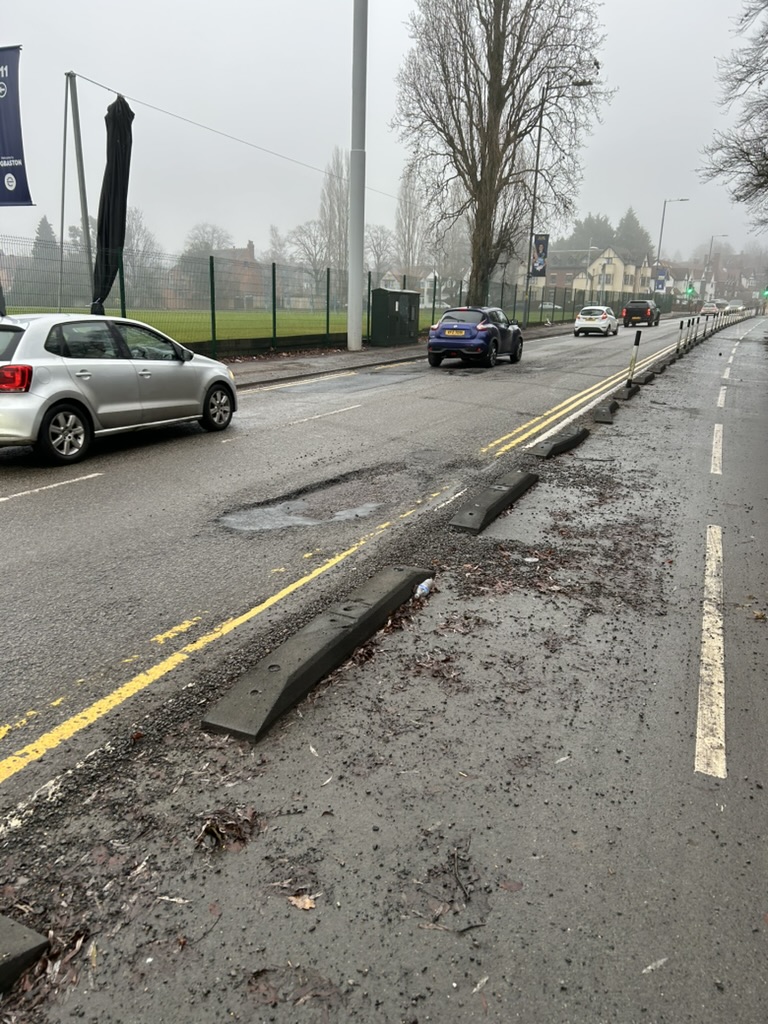
The traffic lights junction at Wake Green Road and Yardley Wood Road has been flagged up to me numerous times as needing road safety improvements. There is no pedestrian phase on the lights, despite Moseley School being close by and it is notorious for collisions and red light jumping.


In April 2024 the campaign group Better Streets for Birmingham held a road safety protest at the junction, attended by residents and politicians after highlighting the amount of red light jumping and speeding.

The wider impact study into Moseley and Kings Heath Places for People (LTN) made recommendations for this junction: a review of signal times , update method of control to MOVA system to assist with congestion, install ASK (Advanced Stop Lines) and upgrade the lights to include a pedestrian phase at all four arms. See Page 20 of the report below.


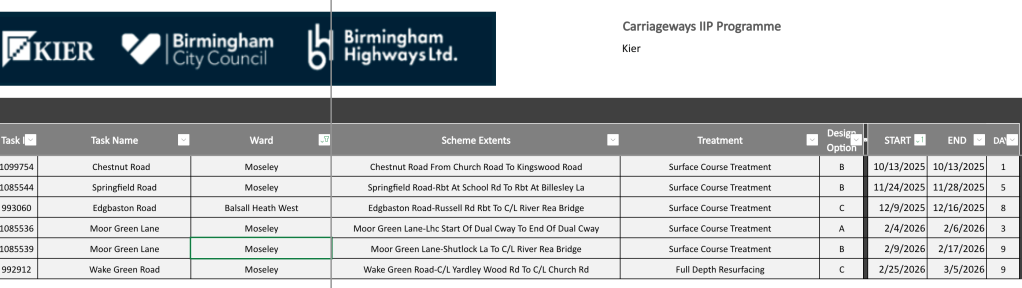
The traffic lights have recently failed and temporary lights are in place. The communications manager at Kier (the company contracted by BCC to maintain highways infrastructure, including traffic lights) has confirmed to me:

I wrote back to ask if this would be an opportunity to upgrade the traffic lights system as recommended in the report, however I was informed this would be a decision for BCC to make. So, I wrote to the Transport team and received this reply:

I have now written back to both the council and Kier to ask if any of the recommendations of the report could be incorporated as part of the repair – however I am not hopeful.

It is helpful though that this site is on the radar and I will continue to look for opportunities to make it safer for all road users.

Places for People (LTN) – new delivery timetable released

The Council has released its updated delivery plan for Kings Heath and Moseley Places for People (LTN). We are disappointed that this scheme has been delayed yet again for another year, and have made representations that this timeline must be adhered to and brought forward if possible.

Full details can be found on the council website here and Birmingham BeHeard website here

Programme for delivery

Measures have been grouped into four packages and will be delivered over the next couple of years as follows:

  • Package 1: improvements to phase 1 measures (to the west of the High Street) including the York Road pedestrian zone – to be delivered July to October 2025
  • Package 2: measures being introduced as part of phase 2 (to the east of the High Street) including new modal filters, one-way streets, and traffic calming – to be delivered July to November 2025
  • Package 3: 20mph speed limit across the project area, including all ‘boundary’ roads and measures on Coldbath Road – to be delivered February to March 2026
  • Package 4: a bus gate on Addison Road and reinstate the right turn from Vicarage Road onto A435 Alcester Road – to be delivered April to June 2026

This timeline is based on the current programme but is subject to change in line with any governance and spend control processes in place.

Elements on all packages are also subject to statutory consultation on Traffic Regulation Orders, to take place before construction.

Cannon Hill Park to Moseley Cycle Lane Extension

Work will start on 4th November to construct the A38 to Moseley cycle spur along Edgbaston Road to Salisbury Road/Park Hill. The work is expected to last approximately 3 months and will involve upgrading the pedestrian crossing on the entrance to Russell Road and constructing a further crossing on Edgbaston Road as it meets Salisbury Road.

This project is funded by the Active Travel Fund, which is ring-fenced funding made available by the government for delivering active travel measures. This funding cannot be allocated elsewhere.

Birmingham City Council has updated it’s Road Safety Strategy – now open to consultation.

Birmingham City Council has updated it’s Road Safety Strategy and released it for consultation.

The Birmingham Road Harm Reduction Strategy has been developed to complement the Birmingham Transport Plan. It sets out to transform Birmingham’s roads and streets to make them safer, more inclusive, and more attractive.

Take part in the consultation HERE

The ambition of the strategy is to end death and serious injury for users of Birmingham’s roads in line with the Vision Zero concept, which aspires to eliminate all traffic fatalities and serious injuries. 

The previous Birmingham Road Safety Strategy was adopted in October 2016. Whilst aligned with Vision Zero, its approach did not tackle traffic volume and its significant impact on road safety.

The revised strategy adopts the Healthy Streets Approach and is aligned directly with the vision, aim, objectives and principles of the Birmingham Transport Plan:

  • Prioritising active travel in local neighbourhoods – upgrading and improving streets in our local neighbourhoods to ensure they are attractive, inclusive, and safe environments for people walking, cycling and using public transport.
  • Reallocating road space – consolidating most motor vehicle journeys in Birmingham onto a defined and prioritised Arterial Route Network, whilst removing through trips from residential streets wherever possible.
  • Transforming the city centre – removing through motor traffic from the city centre, and redesigning public spaces to prioritise public transport, walking and cycling.
  • Managing demand – proactive management of the kerbside (the part of the road closest to the footway) to release the space needed for safe, healthy streetscapes, whilst improving access to local services and facilities.

Paper copies of the consultation survey, along with copies of the strategy will be left at all of the city libraries from the week commencing 15 January 2024 (or you can email Izzy and we’ll send you one). The council also plans to hold a small number of drop in events, details of which will follow.

If you have any queries, please email: connected@birmingham.gov.uk

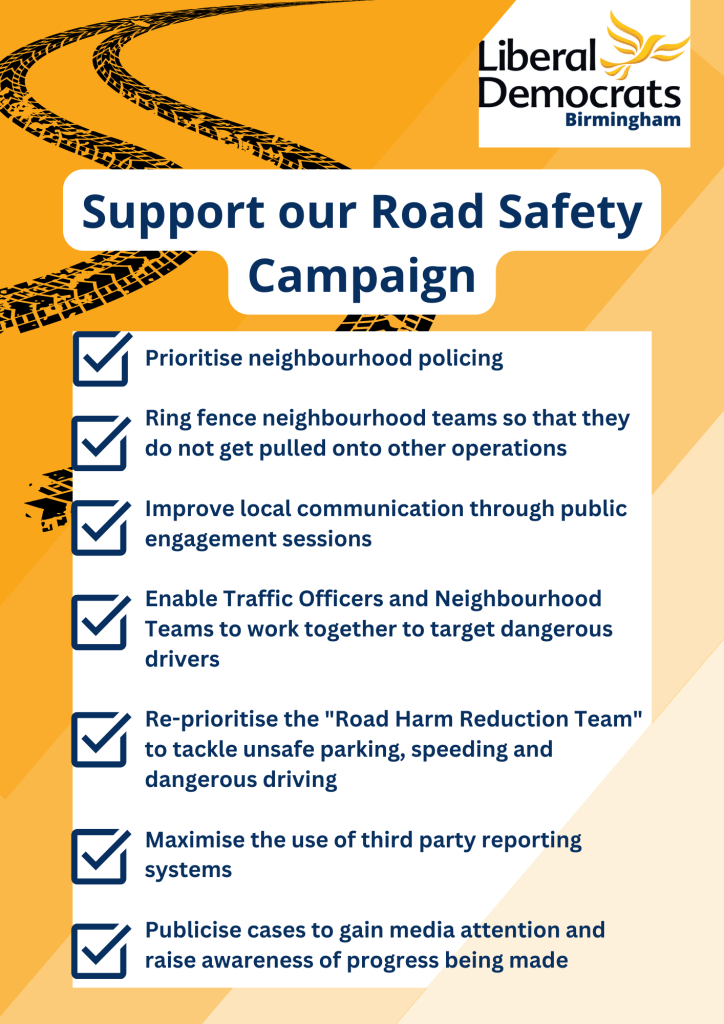
SUPPORT OUR ROAD SAFETY CAMPAIGN

In the past month alone, the lives of eight people and their families have been ended or changed forever through violent driving on our roads.

In response to these tragedies, West Midlands Police released a statement on 19th June 2023 confirming what they already do, not what they will do, to make our streets safer. You can read their full statement here:

This response has done nothing to reassure our communities that West Midlands Police are treating this endemic road violence as a serious emergency.

In April 2023 the Chief Constable Craig Guildford announced a new local policing model which put Neighbourhood Policing at its core, including a pledge for “increased neighbourhood presence”. In reality, our neighbourhood teams are continually being taken away from neighbourhood teams to reduce demand on other services.

Neighbourhood policing must be prioritised if we are to tackle and prevent crime.

Click here to sign our petition

Click here to sign our petition